
Chimney Cap
Is Your Chimney Missing a Cap? Expert install + maintenance.
Learn moreVented gas log sets give the most realistic flame and ember bed, but require a fully open damper (less efficient). Real Fyre, RH Peterson, Empire — all major brands.
Prices shown are starting estimates and may change with the condition, access, and scope we find on site. Only a written quote from an on-site visit is a price we commit to.
Vented gas logs exist for one reason above all others: realism. They burn with a tall, lazy, deep-yellow flame that licks and curls exactly like a wood fire, over a glowing ember bed that a vent-free set simply cannot match — because that gorgeous yellow flame is, chemically, a slightly incomplete burn that produces a little soot and combustion gas, which is why it must vent. Prime Chimney Experts installs vented sets as the premium ambiance upgrade for homeowners who already have a working masonry fireplace and want the fire to look real, in every market we serve.
The flue is the whole foundation, so we start there. A vented set burns into your open chimney just like wood does, so the chimney must be sound, lined, clear, and actually drafting — we inspect and, if needed, sweep it before a single log goes in. How this differs from ventless gas logs installation: a vent-free set is chosen precisely because it needs no chimney and keeps the heat in the room — running damper-closed in a purpose-built vent-free firebox, or damper clamped to a minimum-open position when retrofit into a masonry fireplace; a vented set is the opposite on every count — it lives or dies on the flue, runs with the damper locked fully open, and trades heat for honesty of flame.
Damper-open is the non-negotiable rule of this service, and we build it in physically. A vented set produces combustion byproducts — including carbon monoxide — that must go up the chimney every minute it burns, so the damper can never be closed while there is gas in the firebox. We install a permanent damper clamp or stop (or remove the damper plate entirely) so it physically cannot be shut, even by accident. A closed damper over a live vented set is a carbon-monoxide event, and this clamp is a required part of the install, not an upsell.
We connect the gas to code and build the flame for looks. The gas drop is sized to the set's BTU load, fitted with the sediment trap and approved connector, and manometer-tested before flame. Then comes the craft: we bed the burner so gas diffuses evenly, lay each ceramic log to the manufacturer's diagram, and dress the set with glowing-ember media so the coal bed lights up. With a vented set the goal of the layout is maximum visual drama — a tall flame that wraps the logs — rather than the heat-flat, ODS-governed flame a vent-free unit is forced to run.
We finish by setting your expectations honestly along with the flame. A vented set is a beautiful inefficient heater — most of its warmth rises up the open flue along with the exhaust, exactly as a wood fire's does — so we tell you plainly that you're buying ambiance, not a furnace. If room heat is your real goal, we'll point you to a vent-free set or an insert instead. We commission the burn with a manometer pressure check and an ambient CO test, confirm the damper stop holds, and walk you through lighting it.
What you end up with is the closest thing to a real wood fire that a valve can give you: tall yellow flame, a glowing bed, the look you pictured — venting safely up a flue we verified. The set off the shelf is the same as anyone's; the realism comes from the sound flue, the locked-open damper, and the layout behind it.
At Prime Chimney Experts, a vented gas logs installation is never guesswork. We scope every job from a graded, photographed inspection first — the NFPA 211 level the evidence calls for — so the work is matched to what your flue and masonry actually need, with the report to prove it. The documented inspection is the record the vented gas logs installation is built on.
Chimney inspectionA vented gas logs installation isn't a matter of opinion — it's held to published national standards. Prime Chimney builds every job to the named codes below and documents it, so the work is provably right for an inspector, an insurer, or a future buyer. These are the universal standards; your city's permit and inspection requirements are confirmed with the local authority before we pull the job.
A vented gas log set requires the damper permanently clamped open (or its plate removed) so combustion products always vent up the flue — a closed damper over a live vented flame is a carbon-monoxide event.
Vented logs exhaust into the open chimney, so the flue must be sound, lined, and correctly sized per NFPA 211 to carry the combustion products away; it is inspected and swept before install.
Per NFPA 54, the gas drop is sized to the set's BTU load with a sediment trap ahead of the shutoff and an approved connector, manometer-tested before flame.
Manifold pressure is verified to the rating plate and an ambient CO check is run while the set burns before it is handed over.
Codes cited are the established national standards (NFPA, UL, IRC) that govern this service. The adopted code edition, permit, and inspection requirements vary by city —Prime Chimney verifies them with your local authority having jurisdiction on every job.
Confirm the chimney is sound, lined, and drafting.
Fit a permanent clamp so it stays open.
Connect gas and lay logs for maximum flame.
Manometer and CO test, then demonstrate.
We've worked on 1,000+ DFW homes over 10+ years. Every job — small sweep or full rebuild — runs the same way: certified technicians, written quotes, photo reports, warranty in writing.
The most realistic yellow flame of any gas set
Flue inspected and swept before install
Permanent damper-open clamp fitted as standard
Honest guidance: ambiance over room heat
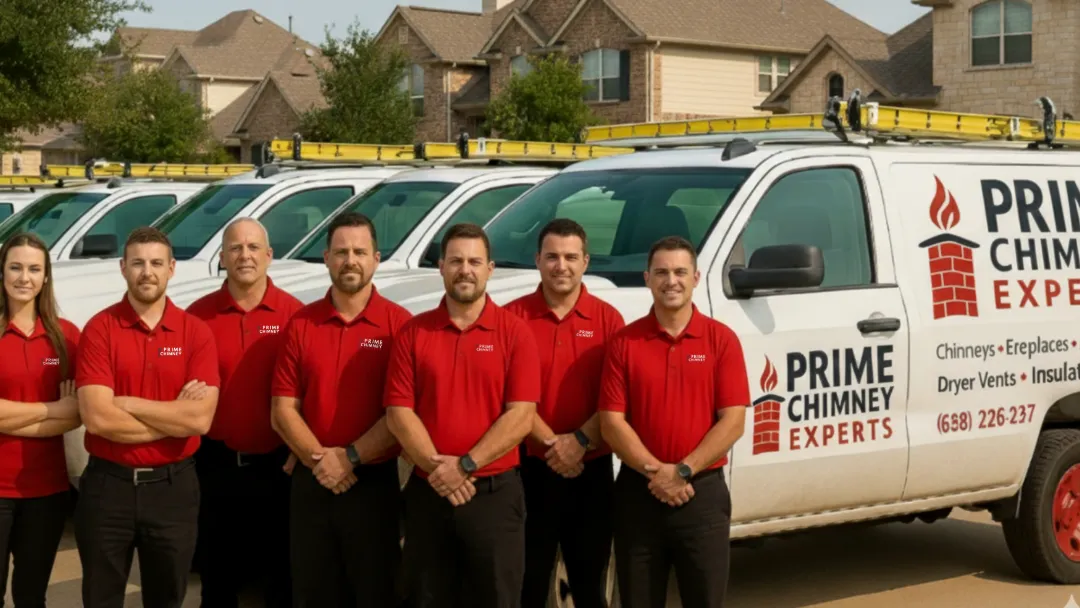
Family-owned, CSIA-certified, NFPA 211–compliant. We're the team you call when you want it done right the first time — no rotating subcontractors, no upsell pressure, no surprises. Same techs, same trucks, same standard.
The NFPA recommends an annual chimney inspection (Level 1), with sweeping done when buildup reaches 1/8" of creosote. For active wood-burning fireplaces, that's typically once per heating season.
Our chimney inspectors hold current CSIA (Chimney Safety Institute of America) certifications, verifiable via the CSIA member directory at csia.org. We also have NFI specialists for fireplace installations.
Yes — emergency response is available 24/7 (subject to crew availability) for active water leaks, animal trapped in flue, post-fire damage, and storm damage. Same-day in most cases.
Always. We provide a written quote before any work begins, with photos of the issues we found. Final pricing depends on chimney condition and any additional work identified during inspection.
Prime Program is our annual maintenance program at $19.99/month ($240/year). Includes: annual Level 1 inspection and sweep ($248 value), priority scheduling, 10% off all repairs, and emergency response priority. Cancel anytime, no contract.
Last reviewed:
Other services in the Installation category.
Free written quote. Same-week scheduling. 24/7 emergency response when you need it.
Active leak, animal in flue, post-fire damage, or smoke event? Real humans on the line 7 AM to 12 AM every day — replies in under 2 minutes. Tech dispatch within 2 hours during business hours, subject to crew availability after-hours.
Emergency line