
Pellet Stove Installation
Code-compliant pellet stove + venting install.
Learn moreDiagnose and repair pellet stove issues — failed augers, burnt igniters, dirty exhaust blowers, control board faults. Includes cleaning since most issues trace back to ash buildup.
Prices shown are starting estimates and may change with the condition, access, and scope we find on site. Only a written quote from an on-site visit is a price we commit to.
A pellet stove is the most electromechanical appliance in the house, and that's exactly why it breaks in ways a wood stove never does. Five systems have to hand off in sequence every time it lights — the auger meters pellets, the igniter heats the burn pot, the combustion blower establishes exhaust flow, a vacuum or pressure switch confirms that flow, and the control board orchestrates the whole startup before the convection fan ever moves heat into the room. When any one link fails, the board refuses to proceed and the stove either won't light or locks out mid-burn. Prime Chimney Experts diagnoses these faults to the component, holding the premium standard on getting the right part right the first time instead of throwing boards at a no-heat call.
Diagnosis starts at the control board, not the parts bin. We read the stored error or status code, then trace it: a no-ignition code points us at the igniter element, the auger feed, or the hopper; a flame-loss or shutdown code points at the combustion blower, the vacuum/pressure switch, or a fouled exhaust path; an over-temp or fan code points at the convection blower or its sensor. Pellet igniters are wear items that fail every few seasons, auger motors seize or shear, and blowers grind their bearings out — but the symptom rarely names the culprit, so we test each link rather than guess. How this differs from pellet-stove-installation: install builds the vent, runs the circuit, and commissions a brand-new stove, while repair never touches the vent route — it isolates and replaces the failed part inside a unit that already passed commissioning.
Fly-ash is the silent driver behind a large share of repairs, and it's why we treat deep-cleaning as part of the fix rather than an upsell. Pellet exhaust packs fine ash into the burn pot holes, the heat-exchanger passages, the exhaust path, and the area around the combustion blower and the vacuum-switch port. That buildup starves the burn of air, which overworks the igniter and blower and trips the safety switch into a lockout — so a 'failed' switch or a 'weak' blower is often a clean stove away from working. We clear the ash the diagnosis points to so the replacement part isn't fighting the same restriction that killed its predecessor.
Every repair closes with a test-burn and an honest repair-versus-replace call. We run the stove through a full light-off, hold it through steady-state, and confirm the combustion and convection blowers, the auger feed, and the safety switches all behave across the cycle, with an ambient CO check before we leave. We quote parts and labor as line items so the math is yours: a single igniter or blower on a healthy stove is an easy yes, but when a fifteen-year-old unit starts stacking board, auger, and blower failures in one season, we'll tell you plainly that a new stove is the better spend.
Pull the error/status code and reproduce the fault.
Test igniter, auger, blowers, switches, and board to the failed part.
Replace the component and clear the fly-ash that caused or masked it.
Full test-burn, safety-switch check, and CO check.
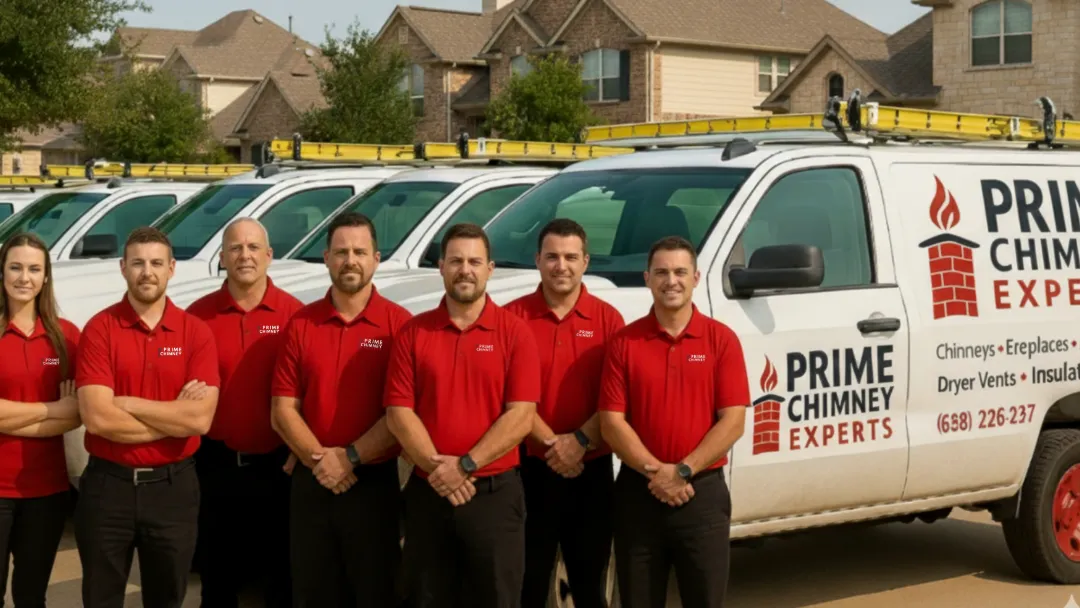
We've worked on 1,000+ DFW homes over 10+ years. Every job — small sweep or full rebuild — runs the same way: certified technicians, written quotes, photo reports, warranty in writing.
Code-read diagnosis to the failed component, not guesswork
OEM-grade augers, igniters, blowers, switches, and boards
Fly-ash deep-clean built into the repair
Honest line-item repair-vs-replace advice
Family-owned, CSIA-certified, NFPA 211–compliant. We're the team you call when you want it done right the first time — no rotating subcontractors, no upsell pressure, no surprises. Same techs, same trucks, same standard.
The NFPA recommends an annual chimney inspection (Level 1), with sweeping done when buildup reaches 1/8" of creosote. For active wood-burning fireplaces, that's typically once per heating season.
Our chimney inspectors hold current CSIA (Chimney Safety Institute of America) certifications, verifiable via the CSIA member directory at csia.org. We also have NFI specialists for fireplace installations.
Yes — emergency response is available 24/7 (subject to crew availability) for active water leaks, animal trapped in flue, post-fire damage, and storm damage. Same-day in most cases.
Always. We provide a written quote before any work begins, with photos of the issues we found. Final pricing depends on chimney condition and any additional work identified during inspection.
Prime Program is our annual maintenance program at $19.99/month ($240/year). Includes: annual Level 1 inspection and sweep ($248 value), priority scheduling, 10% off all repairs, and emergency response priority. Cancel anytime, no contract.
Last reviewed:
Other services in the Pellet Stoves category.
Free written quote. Same-week scheduling. 24/7 emergency response when you need it.
Active leak, animal in flue, post-fire damage, or smoke event? Real humans on the line 7 AM to 12 AM every day — replies in under 2 minutes. Tech dispatch within 2 hours during business hours, subject to crew availability after-hours.
Emergency line